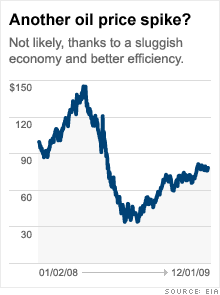
"With oil supplies rising and the economy becoming ever more efficient, a super-spike in prices is looking increasingly unlikely"
Because oil prices have always been directly related to the strength of the economy, a recovery might have seen headlines like these:
• The recession ends: Get ready for $100 oil
• The economy roars: $140 oil, is there an end in sight?
• Everyone in China buys a Cadillac: World tapped out
But a growing number of experts are saying that you can forget all that. For the next couple of years, they say, oil prices will remain well below $100 a barrel as the economy remains fragile and efficiency measures kick in.
"The world will never run out of oil," Deutsche Bank analysts wrote in a recent research note, echoing the old logic that the Stone Age didn't end because the world ran out of stone. "If the oil age does end, it likely will be because we become more efficient and simply use less petroleum."
It's this "becoming more efficient" idea that the Deutsche Bank analysts use to predict even lower oil prices in 2010 than now - an average of $65 a barrel next year compared to nearly $80 currently.
'Drill baby, drill'...no more
To get there, they employ a metric known as energy intensity, which basically measures the amount of oil used in relation to the size of the economy. (Keep an eye on this term in the next couple of weeks - countries at the upcoming Copenhagen summit on climate change will use it to try to wiggle out of making any hard commitments on cutting greenhouse gases.)
The energy intensity of the U.S. economy has actually dropped by about 2% a year every year since the early 1980s. In the next couple of years Deutsche Bank expects it to decline by around 3% as people buy more fuel efficient cars and respond in other ways to the high prices of 2004-2008 and as government conservation measures kick in.
With economic growth expected to remain at a sluggish 2.5% or so over the next couple of years, that translates into an actual drop in U.S. oil consumption.
"US oil demand may have already peaked," the note said.
The bank's numbers aren't far off from what the government is saying either.
U.S. oil consumption, which peaked at almost 21 million barrels a day in 2005, is now under 19 million barrels a day, according to the Energy Information Administration.
"The last time we had a decline in consumption of this magnitude was 1979-82," said Tancred Lidderdale, an oil analyst at EIA. U.S. oil demand isn't expected to near 21 million barrels a day again until 2029.

No comments:
Post a Comment